
Three findings worth checking first
One: 1,024 ways describe positions, not fixed printed paylines or odds. Two: a cascade can continue one paid round rather than charge a new stake. Three: provider and operator specification pages can disagree even about the grid.
The modules below make those distinctions inspectable. We do not substitute a small sample or a promotional win image for the game’s theoretical mathematics.
Trace one of the 1,024 possible paths
The interactive grid is our deterministic diagram of five columns with four positions each. Choosing rows changes a path, not an outcome. The arithmetic is 4 to the fifth power.
Matching-symbol counts can create several qualifying paths through the same reels. That is why reading a ways game as a single fixed payline gives the wrong explanation.
Five columns. Four choices each.
Choose a row in each column to trace one of 1,024 full-width paths. The selected cards are illustrative positions, not a winning result.
Selected rows: 1 → 2 → 3 → 2 → 1. Paths are not probabilities.
Check the cascade accounting
The tool starts with 10 credits staked and illustrative pre-multiplier amounts of 2, 3, 1, 0 and 0. With the first three base factors, returned credits are 2 + 6 + 3 = 11, and net is 1.
In the doubled-ladder example, those same entered amounts return 22. That comparison changes the arithmetic factor only; it does not predict what free games will return. The last two input fields use the terminal 5x/10x factor, which remains in place for later wins within that spin.
Read a paytable without confusing the stake
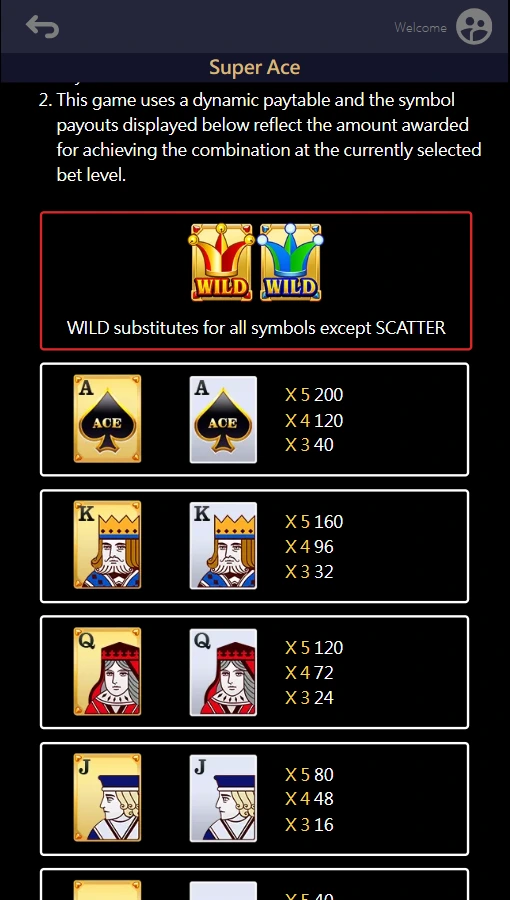
The demo help explicitly says its paytable is dynamic. In our captured screen it displays bet = 80; the Ace row shows 40 for three matches, 120 for four and 200 for five. Those are displayed amounts at that setting, not universal multipliers.
Below are four rows that can be visually checked in the accompanying capture. We have not named unseen rows from their numerical order. Matching starts at the leftmost reel and needs at least three adjacent reels under the inspected rules.
| Card | 3 matching | 4 matching | 5 matching |
|---|---|---|---|
| Ace | 40 | 120 | 200 |
| King | 32 | 96 | 160 |
| Queen | 24 | 72 | 120 |
| Jack | 16 | 48 | 80 |
The paytable is dynamic: changing the stake changes these displayed amounts. A cascade multiplier and the number of qualifying ways affect a result. Do not read this as a payout for any arbitrary spin.
Compare the documents rather than averaging them
Our ledger preserves source URLs, review dates and unresolved differences. In particular, 10,000x on the provider overview and 2,500x on the operator guide remain distinct claims. A mixed five-by-five label is not used to redraw the actual five-by-four grid.
What we checked and what we did not
On 9 October 2026 we inspected the official JILI product page and public demo entry in an English Chromium session, alongside public operator, GCash and PAGCOR sources. Provider-published imagery is labelled separately from our own captures.
This is UI and rules research, not a statistical play study. No complete naturally triggered bonus, funded account, deposit or withdrawal was verified. Desktop resizing does not constitute a physical-phone test.
The public downloads contain a source ledger and deterministic examples. Private session URLs, tokens and network captures are excluded. SHA-256 confirms downloaded bytes, not provider certification or game fairness.
Ready to check a listing?
Match the title and provider before choosing a platform. Our comparison keeps evidence dates and unknowns visible.