
Start with the visible controls
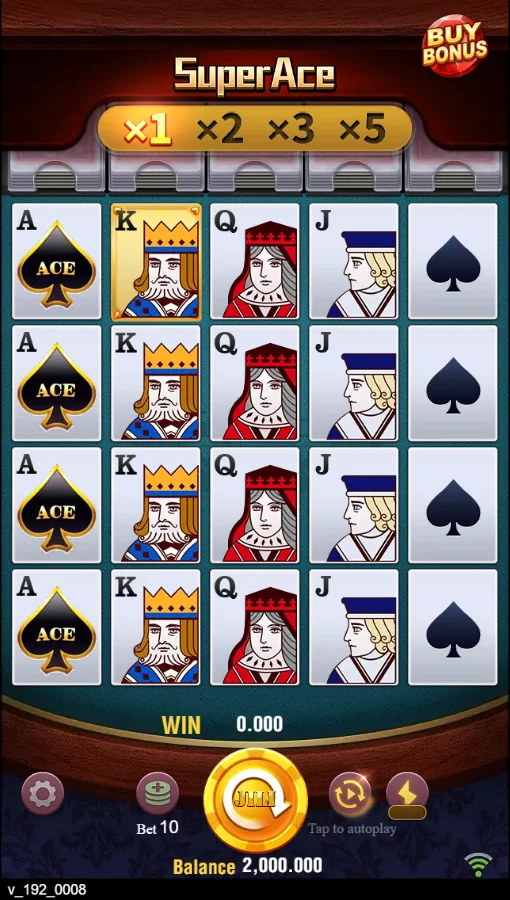
The original game shows five columns and four visible rows, with a multiplier strip above the cards and WIN, bet and balance information below. Read the total stake before using the circular spin control.
The settings and information controls are the place to check the current paytable. The pictures in this guide distinguish our own interface captures from JILI’s published promotional screenshots. A promotional WIN display is not a result from our testing.
Why four rows become 1,024 ways
Imagine picking one visible position from each of the five columns. There are four choices each time: 4 × 4 × 4 × 4 × 4 = 1,024 full-width position paths. They can zigzag rather than follow a printed fixed payline.
The count describes the grid’s combinations, not 1,024 simultaneous wins. A particular paying symbol still has to satisfy its adjacent-reel rule and paytable. The diagram below selects positions only; it does not simulate outcomes or estimate their likelihood.
If a hypothetical symbol has two qualifying copies in column one, one in column two and three in column three, that gives 2 × 1 × 3 = 6 three-column combinations. The applicable payout still comes from the exact symbol’s paytable.
Five columns. Four choices each.
Choose a row in each column to trace one of 1,024 full-width paths. The selected cards are illustrative positions, not a winning result.
Selected rows: 1 → 2 → 3 → 2 → 1. Paths are not probabilities.
One paid spin can contain several results
After a paying combination is removed, replacement cards can continue the round. A later cascade is not necessarily a new paid spin. The visible multiplier strip changes the payout calculation as the sequence develops.
Wait for the round to settle before comparing balances. Do not treat every changing WIN counter as a separate amount to add together: an interface may already be showing a running total.
Returned money is not the same as profit
If a paid round costs 10 credits and all of its cascades return 7, the net result is a loss of 3. A win animation can therefore accompany a losing paid round.
For a complete paid round, use closing balance = opening balance − paid stake + total settled payout. When the paid round triggers free games, include their settled payout before calculating the round’s net result. Our calculator illustrates this distinction without claiming any observed return.
Where Scatters fit into the round
Scatter symbols control the free-game trigger. They are different from paying card symbols and from Golden Cards that transform during cascades. Read the original-game rules before applying a Deluxe description.
Golden hour, patterns and how-to-win claims
Nothing in the evidence we reviewed establishes a profitable hour, a guaranteed pattern or an “unlimited scatter” method. The diagrams explain payouts after a qualifying result; they do not tell you how to produce one.
Changing the stake after a loss changes the next amount at risk. Faster play changes how quickly paid actions occur. Neither establishes an advantage. Set time and spending limits before opening a funded game.
Ready to check a listing?
Match the title and provider before choosing a platform. Our comparison keeps evidence dates and unknowns visible.